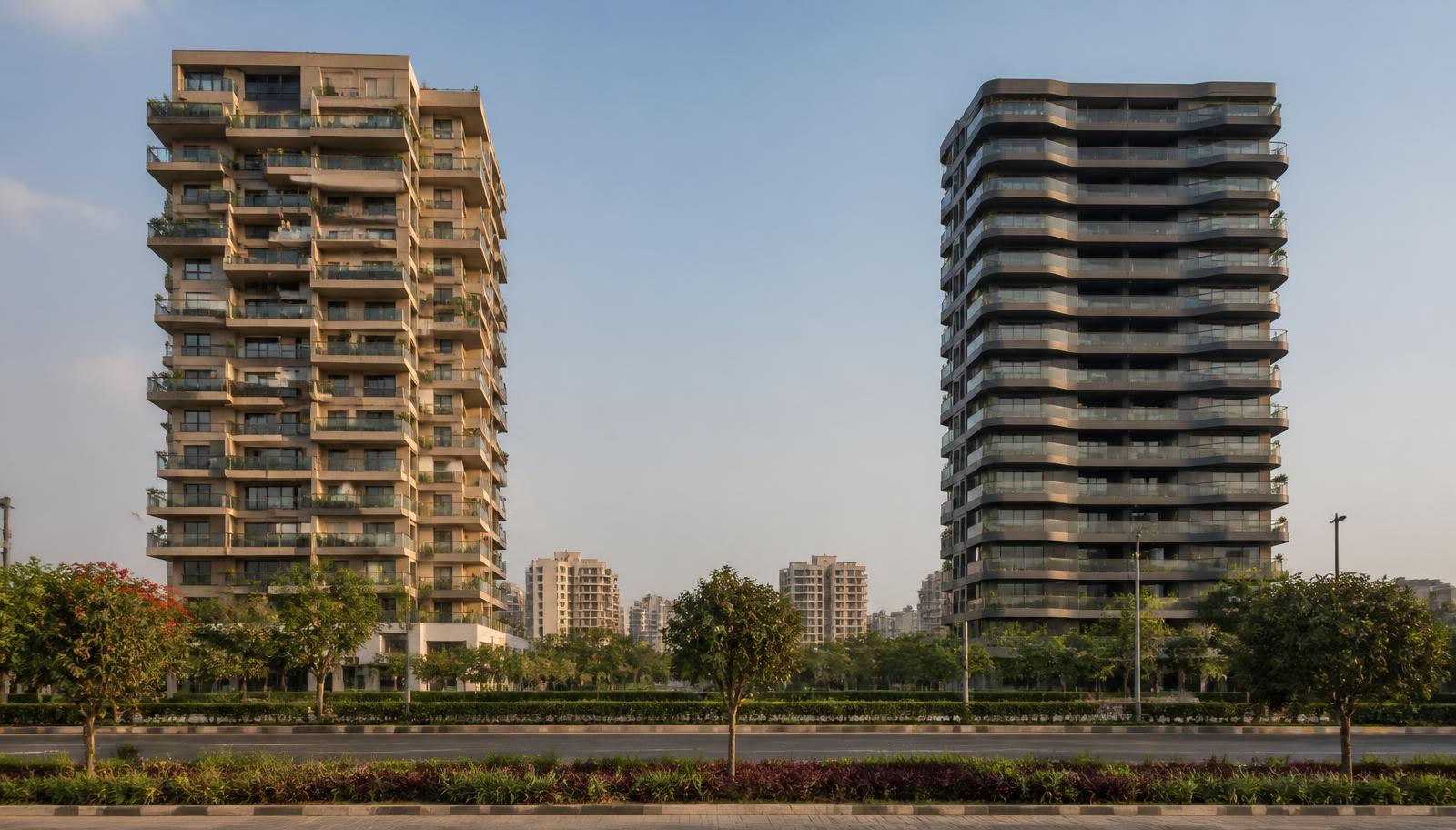
Comparison
Dwarka Expressway vs Golf Course Extension Road: Which is Better?

Both are Gurgaon's headline corridors. Here's how they compare on price, rental yield, appreciation and buyer profile.
Entry price (Jan 2026)
Dwarka Expressway: ₹12,000–18,000/sqft. Golf Course Extension: ₹18,000–28,000/sqft. GCE commands a 40–60% premium.
Rental yield
Dwarka Expressway 2.5–2.9% (still absorbing supply). GCE 3.2–3.8% (mature tenant base of consultants, expats, senior corporates).
5-year appreciation outlook
Dwarka Expressway 12–18% CAGR (infrastructure repricing). GCE 8–10% CAGR (already discovered, driven by scarcity).
Builder mix
Dwarka Expressway: Sobha, Signature Global, Krisumi, Godrej, Experion, Elan. GCE: DLF, M3M, Emaar, Ireo, TARC, Trevoc.
Who should buy where
Investors with a 3–5 year horizon → Dwarka Expressway. End-users, HNIs and long-term hold buyers → Golf Course Extension.
Infrastructure timelines side by side
Dwarka Expressway's 29 km, eight-lane stretch is operational end to end, with the Delhi section elevated over Najafgarh Drain and direct connectivity to IGI Terminal 3 via the tunnel spur. Metro extension to Sectors 101–113 is in the approved-alignment stage. Golf Course Extension Road has a completed six-lane signal-free corridor, the Rapid Metro terminating at Sector 55–56, and the SPR upgrade to a grade-separated corridor under execution. Both corridors are funded; the Expressway's remaining upside is metro-linked, the Extension Road's is office-absorption-linked.
Social infrastructure: the practical difference
Golf Course Extension Road already has operational schools (DPS 67, Heritage Xperiential), hospitals (Artemis, Medanta 8 km), and retail (Elan Miracle, Airia Mall, M3M Broadway). Dwarka Expressway's social layer is arriving in phases — schools in Sectors 102 and 109 are operational, but multi-speciality hospitals and organised retail remain thinner. For a family moving in immediately, Extension Road is the lower-friction choice; for a five-year investor, the Expressway's infrastructure gap is precisely the discount you are buying.
Price gap and convergence maths
Comparable 3 BHK inventory: Dwarka Expressway ₹12,500–17,000/sqft; Golf Course Extension ₹18,000–28,000/sqft. That 35–45% gap has narrowed from 60% in 2020. If the Expressway metro is sanctioned and office delivery continues, historical NCR corridor patterns suggest the gap compresses to 20–25% within four to six years — an implied 25–35% relative outperformance for Expressway inventory, before general market growth.
Which corridor suits which buyer
Choose Dwarka Expressway for: airport-proximate commuting, larger unit sizes per rupee, and appreciation-led investing. Choose Golf Course Extension for: immediate rentability, established schools and healthcare, premium branding, and resale liquidity. NRIs buying sight-unseen usually do better on Extension Road because the asset is easier to lease and manage remotely.
Traffic and daily commute reality versus the marketing pitch
Golf Course Extension Road residents commute to Cyber City and Udyog Vihar in 20-35 minutes outside peak hours, but face significant congestion at the Rajiv Chowk and Iffco Chowk merge points during 9-10 AM and 6-8 PM windows. Dwarka Expressway offers a genuinely signal-free stretch for through-traffic, but local sector roads feeding onto the main carriageway are still under construction in several pockets, meaning the last-mile experience within the sector can be rougher than the highway experience itself. Buyers should physically drive both the highway segment and the specific internal sector road during evening rush hour before assuming the expressway branding guarantees a smooth daily commute.
Flood and waterlogging track record — an underrated factor
Parts of Golf Course Extension Road, particularly near the Sector 58-63 belt, have experienced monsoon waterlogging in past years due to natural drainage patterns and construction-phase disruption of the existing water channels; most established societies have since invested in internal stormwater and pumping infrastructure. Dwarka Expressway's elevated design over the Najafgarh Drain section was specifically engineered to reduce flooding risk on the highway itself, though newer sectors still developing internal drainage infrastructure have shown occasional waterlogging during heavy monsoon spells. Ask any shortlisted project directly for its monsoon performance track record and stormwater drainage certification rather than relying on general corridor reputation.
Air quality and green cover comparison
Golf Course Extension Road benefits from mature tree cover along several internal roads and proximity to the Aravalli biodiversity park, which measurably improves local air quality relative to more built-up parts of the city. Dwarka Expressway's landscaping is newer and thinner in most sectors, though several large townships have committed substantial green-belt allocations as part of their layout plans. Neither corridor escapes Delhi-NCR's broader winter pollution season, but end-users prioritising outdoor lifestyle and walkability should weigh Golf Course Extension's more established green infrastructure against Dwarka Expressway's larger but still-maturing landscaped open spaces.
Cost of ownership beyond the purchase price
Golf Course Extension Road societies, being more mature, generally report more predictable maintenance costs (₹4-8 per sqft per month for premium but non-ultra-luxury projects) since operational inefficiencies have been ironed out over years of RWA management. Dwarka Expressway's newer societies sometimes see higher initial maintenance volatility as facility management contracts get renegotiated and amenity usage patterns stabilise in the first 2-3 years post-possession. Power availability is comparable on both corridors given Haryana's uniform grid supply, but Dwarka Expressway's newer substations occasionally show teething outage issues that mature Golf Course Extension infrastructure has already resolved.
Sector-level noise and pollution profile along each corridor
Sectors directly abutting the elevated Dwarka Expressway carriageway (parts of 102, 106, 113) experience continuous traffic noise that setback distances and double-glazed façades only partially mitigate, and units on lower floors facing the highway directly see measurably higher ambient noise than internal-facing units in the same tower — always ask for a unit facing away from the carriageway if noise sensitivity matters. Golf Course Extension Road's internal sectors are generally set back further from the six-lane carriageway by design, but pockets near the Sector 58-63 industrial-adjacent belt see periodic dust and construction-vehicle movement from ongoing infrastructure works. Neither corridor has independently published ambient noise data, so a physical evening visit to the exact tower and floor you're considering remains the only reliable check.
Transaction mechanics: how resale actually clears on each corridor
On Golf Course Extension, resale transactions are typically driven by local brokers with deep society-specific knowledge, and price discovery references the last two to three registered transactions in the same tower, making negotiations relatively transparent and fast, often 45-75 days end to end. Dwarka Expressway resale, being newer, sees more assignment-stage deals (pre-possession, nomination transfers with developer NOC) than post-possession resale, and pricing here is more volatile because comparable transaction data within the same tower is thinner — buyers should ask for the developer's official co-relation certificate on rate history rather than relying solely on broker-quoted 'circle rate plus premium' figures, which can be inflated during a hot launch phase.
Loan approval friction — a corridor-specific detail
Most major PSU and private banks have empanelled valuers and pre-approved project lists for mature Golf Course Extension societies, meaning loan sanction for a resale unit there is typically fast, three to seven working days for valuation and sanction. Several newer Dwarka Expressway projects, especially those still mid-construction or recently delivered, require a fresh technical and legal valuation each time since they haven't yet built the transaction history that gets a project onto a bank's pre-approved list — this can add one to two weeks to a purchase timeline and occasionally results in a lower sanctioned LTV until the bank's panel valuer is satisfied with the project's construction-stage documentation.
Case pattern: a delayed-possession scenario on each corridor
A common pattern on the Dwarka Expressway in the 2021-2023 launch cohort involved projects sanctioned before final internal road connectivity was complete, leading to HRERA-registered possession dates slipping by 12-24 months as developers waited for external infrastructure agencies (NHAI, HSVP) to complete connecting roads outside their own construction scope — a risk largely specific to newer corridors where private construction outpaces public infrastructure completion. Golf Course Extension's delay pattern, where it occurs, is more often tied to individual developer execution issues (labour, funding) rather than external infrastructure dependency, since the corridor's public infrastructure was substantially complete before most current-generation projects launched. Buyers on newer corridors should specifically ask whether possession is contingent on any external agency's road or utility completion, and get that dependency documented in the agreement.
Frequently asked
- Is Dwarka Expressway better than Golf Course Extension Road?
- Neither is universally better. Dwarka Expressway offers a 35–45% price discount and higher appreciation potential; Golf Course Extension offers mature infrastructure, faster leasing and stronger resale liquidity. Match the corridor to your holding period and whether you plan to live in the unit.
- How long is the drive from Dwarka Expressway to IGI Airport?
- From Sectors 102–113 the airport is typically 20–30 minutes via the expressway and the Dwarka link, versus 35–50 minutes from Golf Course Extension Road depending on the NH-48 stretch.
- Which corridor has better rental demand?
- Golf Course Extension Road currently leads on rental demand because of nearby Grade-A office occupancy. Dwarka Expressway rental demand is rising steadily as new office and retail supply becomes operational.
- Which is a better commute to Cyber City — Dwarka Expressway or Golf Course Extension Road?
- Golf Course Extension Road generally has a shorter, more direct commute to Cyber City at 20-35 minutes, while Dwarka Expressway commutes depend heavily on which sector you're in and can be longer despite the highway itself being signal-free.
- Does Dwarka Expressway flood during monsoon?
- The elevated highway section was engineered to reduce flooding, but some newer internal sector roads still developing drainage infrastructure have shown occasional waterlogging; always check a specific project's stormwater certification.
- Which corridor has lower maintenance charges?
- Golf Course Extension Road societies tend to have more predictable, often lower per-sqft maintenance due to years of operational stabilisation, while newer Dwarka Expressway societies can see higher initial volatility.
- Is the social infrastructure gap between the two corridors closing?
- Yes — schools and small retail are arriving quickly on Dwarka Expressway, though multi-speciality hospitals and large-format malls still lag Golf Course Extension's established base by a few years.
- Is home loan approval slower on Dwarka Expressway than Golf Course Extension?
- It can be, particularly for newer or recently delivered projects that haven't yet built a transaction history with a bank's empanelled valuer, sometimes adding one to two weeks and occasionally reducing the sanctioned loan-to-value until documentation is fully verified.
- Which corridor has more transparent resale pricing?
- Golf Course Extension generally offers more transparent pricing because mature societies have several years of registered same-tower transactions to reference, while Dwarka Expressway resale data is thinner and more dependent on broker-quoted premiums during active launch phases.
- Do Dwarka Expressway possession delays usually relate to the developer or external factors?
- A notable share of delays on this corridor have stemmed from dependency on external agencies completing connecting roads and utilities outside the developer's own scope, which is a distinct risk pattern from the more execution-driven delays typical on established corridors.
Need a free 30-minute consultation on this?
Our senior advisors will help you shortlist projects, verify HRERA and structure your offer.