Comparison
DLF vs M3M in Gurgaon: Head-to-Head Comparison (2026)
DLF and M3M dominate Gurgaon's premium and luxury housing market — but they cater to very different buyer profiles. This head-to-head guide compares project density, construction quality, price bands, delivery track record and historical capital appreciation so you can pick the right builder for your investment or end-use goal.
1. Company DNA — legacy developer vs new-age luxury brand
DLF is India's oldest listed real estate developer (founded 1946) and effectively built modern Gurgaon — DLF Phases 1–5, Cyber City, Golf Course Road. Its projects are anchored around mature, self-contained townships with established social infrastructure. M3M, founded in 2007, is a next-generation luxury developer that has aggressively positioned itself on Golf Course Extension Road, SPR and the Dwarka Expressway with high-density, high-amenity, design-led towers. In short: DLF sells location maturity; M3M sells product design and lifestyle branding.
2. Portfolio scale and project density
DLF's Gurgaon portfolio spans 3,000+ acres of developed land across DLF-1 to DLF-5, Aralias, Magnolias, Camellias, Crest, Ultima, Privana and The Dahlias. Density is generally low — Camellias and The Dahlias sit at under 90 units per acre with extremely large apartment sizes (5,000–16,000 sqft). M3M has delivered/launched 30+ projects including M3M Golf Estate, Golf Hills, Capital, Merlin, Crown, Antalya Hills, Mansion, Malibu and Line. M3M towers typically run 40–50 storeys with higher unit counts per acre, but compensate with 8–12 acre podium amenity decks.
3. Construction quality and specifications
DLF's premium line (Camellias, Crest, The Dahlias, Privana) uses imported marble, VRV air-conditioning, private lift lobbies and structural specifications that match Singapore/Dubai super-luxury benchmarks — but its mid-segment New Town Heights / Regal Gardens inventory is more utilitarian. M3M standardises high spec across categories — smart-home wiring, branded modular kitchens (Miele/Bosch in higher lines), German façade systems and resort-style amenity podiums even in ₹3–5 Cr projects. For pure specification-per-rupee at the ₹4–8 Cr band, M3M often wins; above ₹15 Cr, DLF's ultra-luxury line is in a class of its own.
4. Price bands and current rates (2026)
DLF: New Town Heights / Regal Gardens ₹14,000–18,000/sqft; The Crest / Ultima / Garden City ₹22,000–28,000/sqft; Camellias / Aralias / Magnolias ₹55,000–85,000/sqft; The Dahlias and Privana North ₹1.0–1.8 L/sqft. M3M: Antalya Hills / Capital / Merlin ₹14,000–19,000/sqft; Crown / Mansion / Line ₹22,000–32,000/sqft; Golf Hills / Golf Estate ₹28,000–40,000/sqft. Head-to-head on Golf Course Extension Road, M3M is typically 10–20% cheaper than a comparable-vintage DLF project.
5. Historical capital appreciation
Over the last 7 years (2019–2026), DLF's blue-chip projects (Camellias, Crest, Ultima) have appreciated 90–180%, with Camellias trading up from ₹27,000 to ₹80,000+/sqft in secondary markets. M3M's flagship projects on Golf Course Extension (Golf Estate, Merlin, Sierra) have appreciated 80–140% from launch. Newer M3M launches on SPR and Dwarka Expressway are still in early appreciation cycles — 30–60% gains within 2–3 years of launch. Rule of thumb: DLF delivers steadier compounding on completed inventory; M3M delivers sharper launch-to-possession gains on new inventory.
6. Delivery track record and HRERA complaints
DLF has one of the cleanest delivery records among large Indian developers — most projects are delivered within 12–18 months of committed date, and Occupation Certificates typically arrive before handover. M3M's early projects (Woodshire, Urbana) saw delivery delays of 2–4 years, but post-2020 launches (Sierra, Merlin, Capital, Antalya Hills) are tracking to schedule. Both builders maintain low active HRERA complaint counts relative to portfolio size — verify project-level status on hrera.in before booking.
7. Rental yield and end-use experience
DLF Golf Course Road (Aralias, Magnolias, Camellias, Park Place, Pinnacle) commands the highest rentals in NCR — ₹5–15 L/month for 4–6 BHK units — with near-100% occupancy from expat and CXO tenants. M3M Golf Estate and Merlin achieve ₹2–5 L/month rentals. Yields are similar (2.0–2.8%), but DLF's mature townships offer better resale liquidity due to established schools, clubs and retail. M3M compensates with newer amenity design — infinity pools, wellness decks, sky lounges.
8. Which builder for which buyer
Choose DLF if you want: (a) blue-chip resale liquidity, (b) mature social infrastructure, (c) ultra-luxury inventory above ₹15 Cr, or (d) established rental income. Choose M3M if you want: (a) modern spec at a lower ₹/sqft, (b) higher launch-to-possession appreciation, (c) resort-style amenities in a ₹3–8 Cr budget, or (d) exposure to emerging corridors like SPR and Dwarka Expressway before they mature.
Maintenance, facility management and living experience
DLF projects are largely managed by DLF's own facility arm with long operating histories and predictable, if premium, maintenance charges. M3M's newer towers rely on third-party facility managers with amenity-dense podiums that are excellent when fully commissioned and expensive to run when occupancy is still ramping. Ask for the current per-sqft maintenance charge and the RWA handover status before committing — in a 4,000 sqft unit that difference is worth lakhs annually.
Financing and bank approval depth
Both developers' major projects are approved by all large lenders, but DLF's completed inventory typically gets faster loan processing and higher valuations from bank panel valuers because of transaction-history depth. For under-construction M3M inventory, confirm the specific tower is on the lender's approved list rather than relying on a project-level approval.
Resale mechanics in each portfolio
DLF Golf Course Road inventory has continuous secondary-market activity and published per-sqft benchmarks, making price discovery straightforward. M3M resale is thinner in newly delivered towers and often competes with unsold primary inventory from the developer — which caps resale pricing until the project sells out. If a short exit horizon matters, that primary-inventory overhang is the single most important thing to check.
Land bank strategy — owned reserves versus joint development
DLF's dominant position rests substantially on a legacy land bank acquired decades ago at a fraction of today's cost, giving it structural margin advantages and the ability to phase launches across decades without the pressure of fresh land-acquisition economics. M3M, as a newer entrant, has grown primarily through fresh land acquisition and, increasingly, joint-development and joint-venture arrangements with landowners and other developers to access prime corridors without the multi-decade land-holding cost DLF benefits from. This structural difference explains part of the price gap on comparable-vintage projects — DLF can price competitively while protecting margin because its land cost basis is low, whereas M3M's newer land acquisitions carry current-market land cost baked into launch pricing, which is one reason M3M's newest launches on SPR and Dwarka Expressway are priced closer to prevailing market rates than at a structural discount.
Amenity philosophy and how it affects long-term maintenance cost
DLF's mature townships (Phase 1–5) integrate amenities at a community level — shared clubs, parks and commercial strips serving multiple towers — which distributes maintenance cost across a larger resident base and has historically kept per-unit charges more predictable over decades. M3M's tower-specific podium amenity model concentrates high-end facilities (infinity pools, sky decks, dedicated concierge) within each project, which delivers a more immersive single-project experience but means maintenance cost is borne entirely by that project's smaller resident base, making per-sqft charges more sensitive to occupancy ramp-up in newly delivered towers. Buyers should model a five-year maintenance cost projection for any M3M tower still filling up, since charges in newly handed-over amenity-heavy towers often run higher in the first two to three years before occupancy stabilises the cost base.
Design language and target buyer psychographics
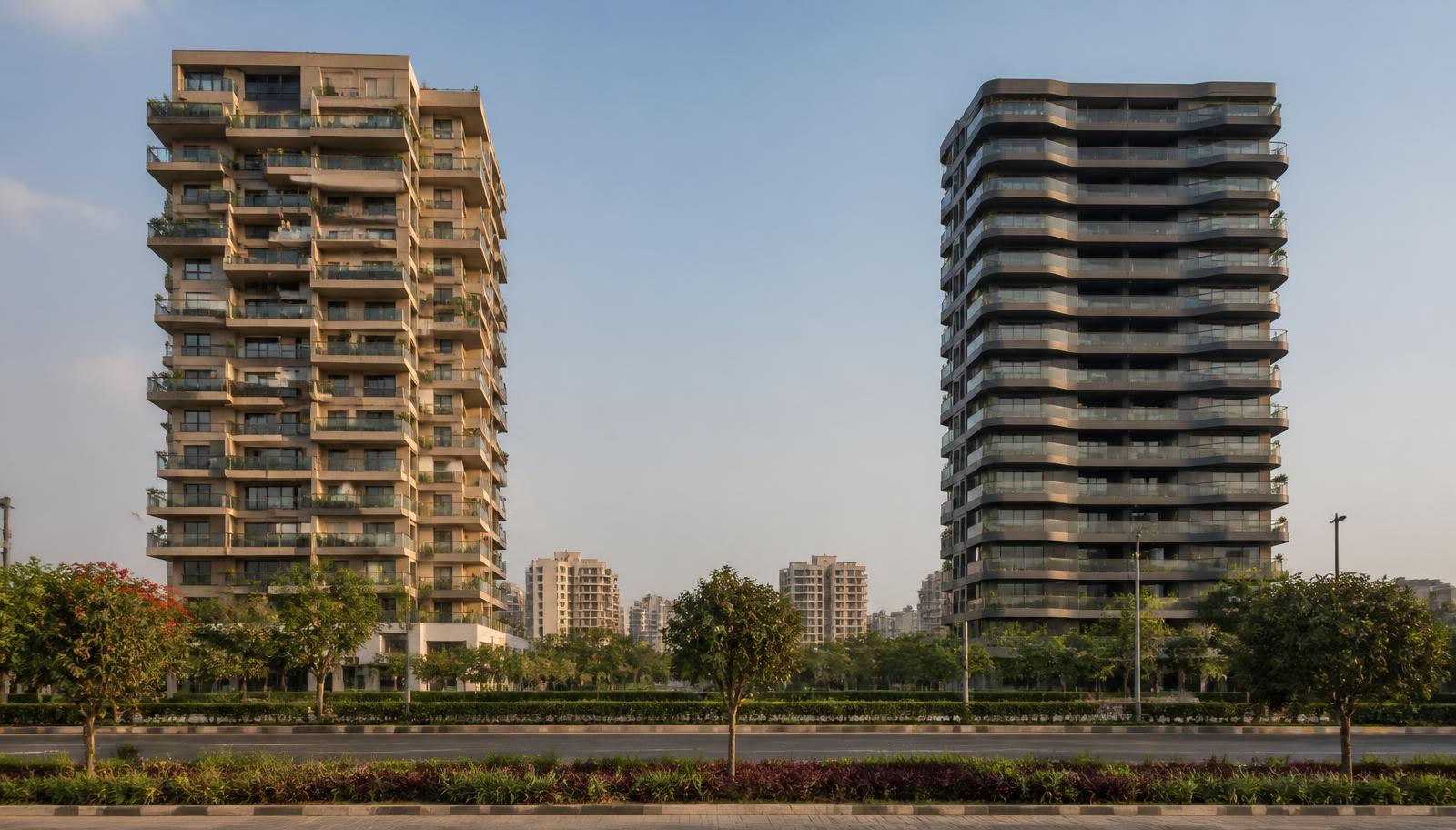
DLF's premium and ultra-luxury lines lean toward understated, heritage-inflected design language — large uninterrupted floor plates, classical material palettes, and a philosophy that the address itself, not the architecture, is the primary status signal. M3M's design language is deliberately more expressive and contemporary — dramatic facades, branded interior collaborations, and amenity-forward marketing that positions the building itself as a lifestyle statement. This is not merely aesthetic — it reflects different buyer psychographics: DLF's ultra-luxury buyer often already has an established social identity and values discretion and legacy, while M3M's target buyer, frequently a first-generation wealth creator or senior corporate executive, is often drawn to visible, contemporary markers of arrival. Neither approach is objectively superior; the right fit depends entirely on the buyer's own preference and how they intend to use the property.
Commercial and retail portfolio spillover effects on residential value
DLF's integrated commercial portfolio — Cyber City, DLF Mall of India, Cyber Hub — creates a self-reinforcing ecosystem where residential value in DLF's own townships benefits directly from footfall, employment and social infrastructure the group itself developed, a vertically integrated advantage few Indian developers can replicate. M3M has built a growing commercial and retail presence (M3M Cosmopolitan, M3M Broadway, M3M Urbana) that similarly supports residential value in its immediate catchment, though at a smaller cumulative scale than DLF's decades-long commercial buildout. For a residential buyer, understanding whether a project sits within a developer's broader integrated ecosystem or stands as a relatively isolated residential launch materially affects the long-term social-infrastructure trajectory of that specific address.
Secondary market broker networks and price transparency differences
DLF's decades of secondary-market transaction history in Phase 1–5 and Golf Course Road have produced a dense, competitive broker ecosystem with relatively transparent per-sqft benchmarking, since so many comparable transactions exist across so many years. M3M's secondary market, concentrated in projects delivered over roughly the last decade, has fewer comparable transactions per project, meaning price discovery relies more heavily on individual broker relationships and can show wider bid-ask spreads between listed and actually transacted prices. Buyers and sellers in M3M's secondary market should specifically request recent registered transaction data from the sub-registrar rather than relying solely on listing prices, which tend to be less anchored to realised transaction benchmarks than in DLF's more mature resale ecosystem.
Which builder aligns better with different investor risk profiles
A capital-preservation-focused HNI with a long horizon and lower urgency for cash flow generally aligns better with DLF's ultra-luxury completed inventory, where liquidity, brand permanence and steady compounding matter more than sharp near-term gains. A growth-oriented investor comfortable with construction-period risk in exchange for potentially sharper launch-to-possession appreciation, particularly on emerging corridors like SPR and Dwarka Expressway, may find M3M's newer launches better aligned with their risk-return appetite. Neither builder is a uniformly better choice — the right decision depends on matching the specific project's price band, delivery stage and corridor maturity to the investor's own time horizon, income needs and risk tolerance, and Reality Choice generally recommends evaluating specific projects on their individual HRERA status and construction progress rather than choosing a builder in the abstract.
Frequently asked
- Is DLF or M3M better for investment in Gurgaon?
- For steady long-term compounding on completed inventory, DLF's Golf Course Road portfolio has the longest proven track record. For higher launch-to-possession gains, new M3M launches on SPR and Dwarka Expressway have historically delivered 30–60% appreciation in 2–3 years. Match the builder to your holding horizon.
- Which is cheaper — DLF or M3M?
- On a like-for-like Golf Course Extension comparison, M3M is typically 10–20% cheaper per sqft than a comparable DLF project. DLF's ultra-luxury line (Camellias, The Dahlias) sits in a separate ₹80,000–1.8 L/sqft band with no direct M3M equivalent.
- Do M3M projects have delivery risk?
- Early M3M projects (Woodshire, Urbana) saw 2–4 year delays, but post-2020 launches are tracking to committed timelines. Always verify project-level HRERA status, completion date and construction stage on hrera.in before booking.
- Which builder has the best amenities in Gurgaon?
- M3M leads on amenity density — 8–12 acre podium decks with infinity pools, sky lounges and wellness zones even in ₹3–5 Cr projects. DLF's amenities are integrated into wider township infrastructure (DLF Golf & Country Club, private clubs at Camellias/Aralias) rather than concentrated in a single tower podium.
- Which builder has better construction quality, DLF or M3M?
- At the ultra-luxury end DLF's specification and structural standards are the benchmark. In the ₹4–8 Cr band M3M frequently delivers more specification per rupee, with branded fittings and larger amenity decks.
- Which is better for rental income?
- DLF Golf Course Road commands the highest absolute rents and the deepest expat and CXO tenant pool. M3M Golf Estate and Merlin lease well but at lower absolute rents with similar yields.
- Why is DLF often cheaper than a comparable M3M project despite being the more established brand?
- DLF's legacy land bank was acquired decades ago at a much lower cost basis, allowing it to price competitively while protecting margin, whereas M3M's newer land acquisitions carry current market land cost that gets built into launch pricing.
- Do M3M projects have higher maintenance charges than DLF?
- Newly delivered M3M towers with amenity-heavy podiums can carry higher per-square-foot maintenance in the first two to three years before occupancy stabilises the cost base, while DLF's mature townships distribute maintenance across a larger, established resident base.
- Is it harder to find comparable resale prices for M3M projects than DLF?
- Yes, M3M's secondary market has fewer comparable transactions per project since most projects were delivered within the last decade, so it is worth checking registered sub-registrar transaction data rather than relying only on listing prices.
- Which builder is better for a long-term capital preservation strategy?
- DLF's ultra-luxury completed inventory generally suits capital-preservation-focused buyers due to its liquidity, brand permanence and steady historical compounding, while M3M's newer launches suit investors comfortable with construction-period risk for potentially sharper appreciation.
- Does DLF's commercial portfolio actually benefit its residential projects?
- Yes, DLF's integrated commercial assets like Cyber City and Cyber Hub create employment, footfall and social infrastructure that directly support residential value in DLF's own townships, a vertically integrated advantage that is harder for newer developers to replicate at the same scale.
Need a free 30-minute consultation on this?
Our senior advisors will help you shortlist projects, verify HRERA and structure your offer.