
Investment Guide
Upcoming Infrastructure Projects That Will Increase Property Prices
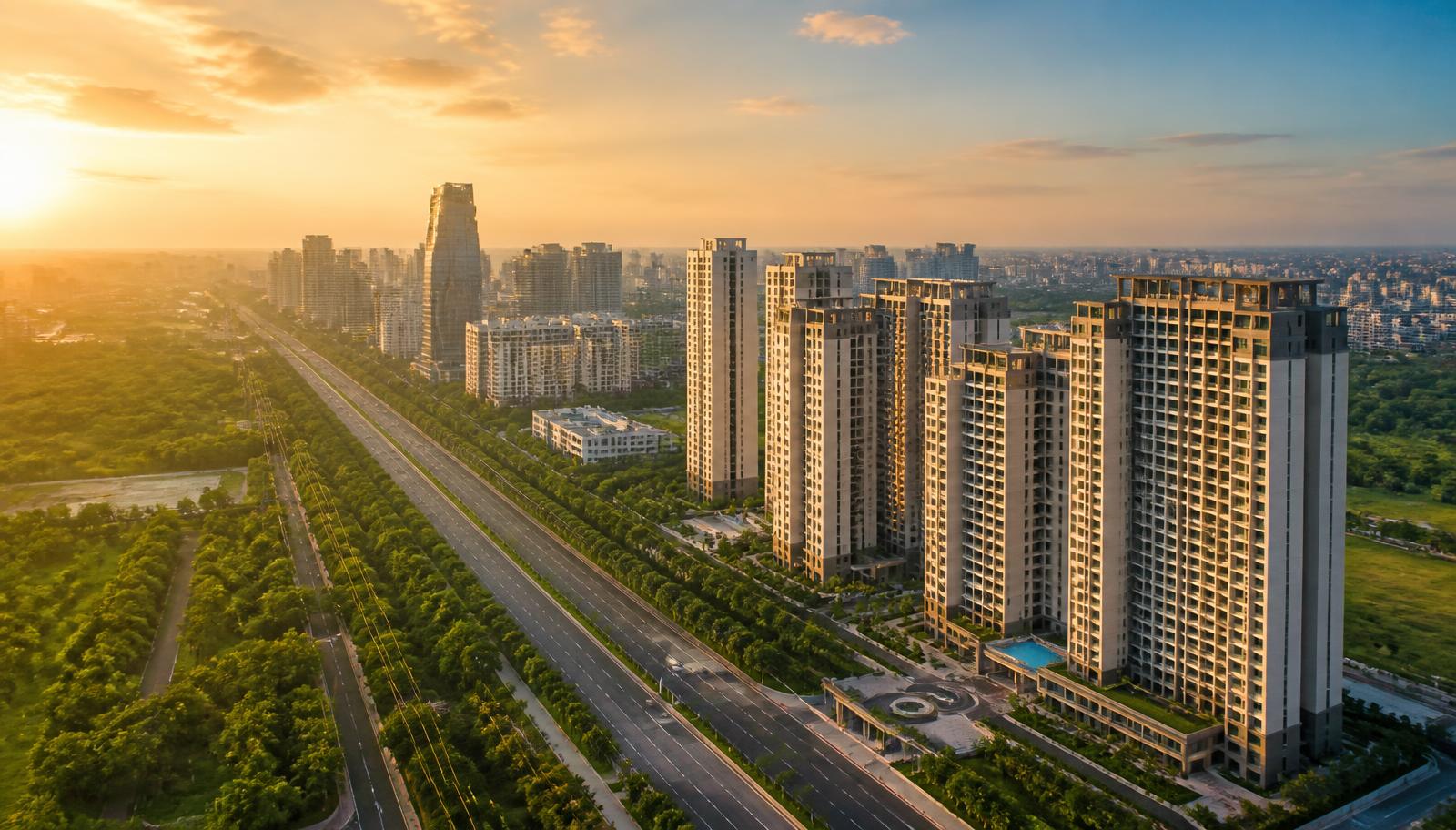
Infrastructure precedes appreciation. Here are the 8 upcoming projects that will re-rate Delhi NCR property values through 2030.
Gurgaon Metro (Cyber City–IFFCO Chowk extension)
Sanctioned. Will directly benefit Old Gurgaon, Palam Vihar and Sector 22–23.
Delhi–Meerut RRTS full operationalisation
Cuts Delhi to Meerut to 55 minutes. Ghaziabad and Meerut sub-markets will re-rate 15–25%.
Delhi–Mumbai Expressway (Sohna–Dausa)
Operational. Sohna land prices already up 30% since 2022.
Dwarka Expressway (fully open)
Fully operational since 2024. Absorption still catching up with supply — 3-year window.
Global City, Gurgaon (1,000 acres)
HSIIDC master-planned by HDA — will re-rate Sector 36, 37 and Manesar catchment.
SPR (Southern Peripheral Road) 90-metre upgrade
Under execution. Golf Course Extension → Sohna axis becomes seamless.
Jewar Airport (Noida International)
Phase 1 operational 2025. Yamuna Expressway and Sector 22D residential land already up 40%.
Northern Peripheral Road spurs
New link roads connecting Dwarka Expressway to KMP — unlocks Sector 84–95.
Funded versus announced — the only distinction that matters
Price impact follows funding and tendering, not announcements. Projects with an approved DPR, allocated budget and awarded contracts move markets; projects with only a press release do not. Historically, land values rise in three waves: 5–12% on funding approval, another 10–20% during construction, and a final 8–15% within a year of commissioning. Buying at the announcement stage means carrying the risk of indefinite delay.
Corridors to watch across NCR
The Gurugram metro extension loop, the Dwarka Expressway metro alignment, the SPR grade-separation upgrade, the Delhi–Alwar RRTS with stations serving south Gurgaon, the Jewar international airport catchment reshaping Noida–Greater Noida pricing, and the Faridabad–Jewar link. Each has a distinct maturity date — mapping your purchase to the corridor most likely to commission inside your holding period matters more than picking the biggest project.
How to translate a project into a buying decision
Draw an 800-metre radius around confirmed station locations — that is where the premium concentrates. Check whether the surrounding land is licensed for group housing or still agricultural; unlicensed land near a station takes years longer to convert into sellable inventory. Then verify current pricing has not already priced in the infrastructure; if the sector jumped 25% on announcement, much of the gain has already been paid to the previous owner.
Downside scenarios worth planning for
Alignment changes that move a station a kilometre away, funding reallocation, and land-acquisition litigation are the three most common causes of stalled infrastructure in NCR. Protect yourself by buying assets that stand on their own fundamentals — existing employment access, schools and road connectivity — with infrastructure as upside rather than as the entire thesis.
How to read a DPR and a budget allocation before you buy on the story
A Detailed Project Report tells you the actual alignment, land requirement and phasing of an infrastructure project, and it is publicly available on the executing authority's website (NHAI, HSIIDC, NCRTC, DMRC) once finalised. Cross-check the DPR's land-acquisition status — a project can have a sanctioned DPR yet stall for years if land acquisition litigation is pending in even a small stretch. The state or central budget allocation for that specific project, not the total scheme outlay, tells you how fast the current year's construction will actually progress; a token allocation of a few crore against a multi-thousand-crore project is a signal to wait. Tender award dates and the contractor's track record on similar projects (check their last two completed contracts for time overrun) are better predictors of commissioning than any government press statement.
The Global City effect on surrounding land values
Gurgaon's Global City project, planned as an integrated mixed-use district near Sector 36 and Dwarka Expressway, has already triggered land-rate increases in the immediate catchment even before construction visibly progresses, because institutional master-planning signals long-term commercial anchor demand. History from similar integrated township announcements in NCR shows the pattern: agricultural and licensed land within 2–3 km typically re-rates first, followed by group-housing land within 5 km once the first commercial anchor is confirmed. Buyers should distinguish between land inside the officially notified project boundary, which carries direct execution risk tied to the authority's timelines, and peripheral private developer land that merely benefits from proximity — the latter is often the better risk-adjusted entry because it does not depend on a single mega-project's execution.
Delhi-Mumbai Expressway's ripple effect beyond Sohna
Beyond the well-known Sohna land re-rating, the Delhi-Mumbai Expressway's Haryana stretch is improving freight and logistics economics along its interchanges toward Nuh and further into Rajasthan, indirectly benefiting Gurgaon's industrial and warehousing catchment on the southern side of the city. For residential buyers, the practical takeaway is improved weekend and long-distance connectivity toward Jaipur and Rajasthan hill destinations, which has modestly lifted second-home interest in Sohna's plotted developments. The expressway's interchange design means value concentrates specifically around access points, not uniformly along the corridor — a plot 500 metres from an interchange behaves very differently in resale liquidity than one 4 km away with no direct access.
Water, sewage and power augmentation — the invisible infrastructure that enables growth
Every headline road or metro project depends on parallel augmentation of water supply, sewage treatment capacity and power substations, and these unglamorous projects are frequently the actual bottleneck that delays occupation certificates for new towers. Gurgaon's dependence on the Yamuna and groundwater has pushed HSVP and GMDA to commission new water treatment and reuse infrastructure alongside the Dwarka Expressway and SPR corridors — buyers should specifically ask developers for the sanctioned water and power load certificate for their tower, not just the road-connectivity pitch. A sector with excellent road access but an unresolved water-augmentation plan can see possession delays even after the building itself is structurally complete, because OC is contingent on utility clearances as much as construction completion.
Reading state budget signals for infrastructure funding continuity
Haryana's annual budget allocations to HSVP, GMDA and PWD for road and utility works are a leading indicator of which corridors will see continued execution momentum versus which face funding slowdown. A corridor that received strong allocation two years running and is now seeing a cut warrants caution, even if the DPR remains technically valid, because contractor mobilisation slows sharply when payments lag. Similarly, central schemes like Bharatmala and the National Infrastructure Pipeline publish annual physical progress reports that list percentage completion by stretch — this is more reliable than local news coverage, which tends to report inauguration dates optimistically.
The compounding effect of overlapping infrastructure
The strongest re-rating historically happens where two or more infrastructure projects overlap in the same catchment within a short window — for example, a sector that gets both a metro station and a widened arterial road within 18 months of each other typically appreciates faster than the sum of each project's individual effect, because it simultaneously improves both mass-transit and private-vehicle access. Sectors along Dwarka Expressway that will eventually see both the operational expressway and a future metro alignment sit in this overlap category, which is part of why institutional developers concentrated launches there ahead of most retail buyers recognising the pattern. When shortlisting a sector on an infrastructure thesis, map every confirmed project within a 3 km radius rather than evaluating a single headline project in isolation.
Practical due diligence before buying on an infrastructure story
Visit the physical site of the infrastructure project, not just the plot you intend to buy — a construction yard, a functioning survey team and visible earthwork are far more reliable signals than any brochure claim. Request the RTI-disclosed land acquisition award status for that specific stretch if litigation history is a concern; acquisition disputes are public record and searchable through the respective authority. Speak to at least two independent local brokers who are not affiliated with the project you are buying, since developer-appointed sales teams have a structural incentive to overstate infrastructure timelines. Finally, build a base case that assumes a 12–24 month delay beyond the officially stated commissioning date — NCR's infrastructure execution history justifies this margin of safety almost without exception.
NH-48 decongestion works and their localised effect on Sector 15-18 pricing
Ongoing decongestion and underpass works along NH-48 through Gurgaon's older sectors are aimed at easing the chronic Rajiv Chowk to Kherki Daula bottleneck rather than adding new capacity, and their price effect is narrower and more localised than a new corridor announcement — properties directly fronting the newly de-bottlenecked stretch see faster commute-time improvement than those a kilometre away on internal roads that still feed into the same choke points. Buyers evaluating older sectors like 14–18 on the strength of NH-48 works should distinguish between an underpass that removes a specific signal-controlled intersection and a broader elevated-corridor project, since the former delivers a smaller, faster, more certain improvement while the latter carries longer execution timelines and larger but less certain upside.
RRTS Delhi-Alwar corridor and its indirect Gurgaon-Sohna benefit
The Delhi-Alwar RRTS alignment, planned to pass through the Gurgaon-Sohna-Rewari-Alwar belt, is a separate and slower-moving project from the Delhi-Meerut RRTS that is already operational, and its Gurgaon-facing stretch remains in earlier planning and land-acquisition stages compared to more advanced NCR RRTS corridors. Because high-speed regional rail primarily competes with intercity car travel rather than intracity commuting, its residential price effect concentrates around planned stations themselves rather than diffusing broadly across a sector, similar to how existing metro stations create a sharper value gradient within 500 metres than within 2 kilometres. Buyers betting on this corridor's Sohna-side stations should track the specific station location finalisation, which has historically shifted during DPR revisions, before assuming a fixed catchment.
Manesar-Bawal industrial corridor upgrades and spillover into southern Gurgaon residential demand
The Kundli-Manesar-Palwal Expressway and the broader Manesar-Bawal industrial model township upgrades are steadily deepening the manufacturing and auto-ancillary employment base south and southwest of Gurgaon, a slower but more employment-dense driver of residential demand than headline expressway projects, because it directly creates blue-collar and mid-management housing demand in Manesar, Bilaspur and the Sohna-Manesar corridor rather than the white-collar demand driving Golf Course Road-style appreciation. Investors should note this demand segment behaves differently — it favours affordable and lower-mid-segment housing with strong rental demand from factory staff and supervisory-level employees, rather than the capital-appreciation-led investor demand seen in Gurgaon's northern and central sectors.
Sewage treatment and STP capacity as a specific gate for new sector occupation certificates
Haryana's environmental clearance framework increasingly ties a project's occupation certificate to demonstrated sewage treatment capacity, either through a dedicated in-project STP or a tie-in to a sector-level government STP with confirmed spare capacity, and several new-sector projects along Dwarka Expressway and SPR have faced OC delays specifically tied to STP commissioning timelines rather than construction delays. A prospective buyer can request the project's sewage NOC and the specific STP it discharges into as a distinct due-diligence item from the general HRERA checklist, since this single document has proven a more reliable predictor of on-time possession in new sectors than the builder's construction-progress photographs.
How airport-linked infrastructure differs from road and rail catalysts in its price transmission
IGI Airport's Terminal 3 expansion and the broader airport-city ecosystem developing around it transmit value differently from a metro or expressway — the effect concentrates heavily on time-to-terminal for frequent flyers (a genuinely valued attribute for the NRI and expatriate-executive buyer segment) rather than on daily commute utility for the general workforce, which is why Dwarka Expressway's airport proximity has been marketed heavily to NRI buyers specifically rather than to the broader end-user base that values office proximity more. This segment-specific transmission means airport-driven demand can be more cyclical, tracking international travel and posting cycles of expatriate executives, rather than the steadier structural demand created by an office-led corridor.
A framework for weighting multiple simultaneous infrastructure claims in one pitch
When a single project's marketing lists five or six infrastructure catalysts simultaneously — metro, expressway, RRTS, airport, Global City, industrial corridor — assign each claim a separate confidence weight based on its actual execution stage (operational, under-construction, DPR-approved, or merely proposed) rather than treating the list as cumulative certainty. A sector genuinely benefiting from one operational catalyst and one under-construction catalyst has a fundamentally stronger and more time-bound thesis than a sector citing four proposed-stage projects, even though the latter's marketing brochure may look more impressive; weighting by execution stage rather than by count of claims is the single most useful discipline in evaluating an infrastructure-driven pitch.
Frequently asked
- How much do property prices rise near a new metro station?
- Historically 15–30% cumulatively across the funding, construction and commissioning phases, concentrated within about 800 metres of the station.
- Should I buy before or after infrastructure is announced?
- The best risk-adjusted window is after funding approval and contract award but before construction is visibly advanced. Pre-announcement buying offers the largest upside with the largest delay risk.
- Which NCR infrastructure project will have the biggest impact?
- Jewar airport's operational ramp-up and the Gurugram metro extension are the two with the widest catchment effect, though they influence very different sub-markets.
- How do I check if an infrastructure project near a property is actually funded?
- Check the executing authority's published DPR and current-year budget allocation, not just news announcements, and confirm whether land acquisition for the relevant stretch is complete or still under litigation.
- Does the Delhi-Mumbai Expressway benefit Gurgaon residential prices directly?
- Its clearest direct residential impact is on Sohna's plotted and group-housing land, while its broader effect is on industrial, warehousing and second-home demand toward Rajasthan-facing interchanges.
- Why do some infrastructure-linked sectors not appreciate despite project completion?
- Because parallel utility infrastructure like water, sewage and power augmentation was not completed alongside the road or metro project, delaying occupation certificates and effective livability even after the headline project opens.
- Is it better to buy land inside an official project boundary like Global City or just outside it?
- Land outside the notified boundary but within the benefit catchment often carries lower execution risk, since it does not depend on a single mega-project's land acquisition and construction timeline.
- How much delay should I plan for when buying on an infrastructure timeline?
- A margin of 12 to 24 months beyond the officially announced commissioning date is a reasonable planning assumption based on NCR's historical execution record.
- Does the Delhi-Alwar RRTS already benefit Gurgaon property prices?
- Its Gurgaon-Sohna stretch remains in earlier planning stages compared to the operational Delhi-Meerut RRTS, so its price effect is currently more speculative and concentrated near planned station locations that have historically shifted during DPR revisions.
- Why do some new-sector projects get delayed even after the building is structurally complete?
- Occupation certificates increasingly require demonstrated sewage treatment capacity, either through an in-project STP or a confirmed tie-in to a sector-level STP, and delays in this utility clearance are a common but under-reported cause of possession delays.
- Should I trust a project that lists five different infrastructure catalysts in its brochure?
- Weight each claim by its actual execution stage rather than treating the count of catalysts as cumulative certainty — a sector with one operational and one under-construction project usually has a stronger thesis than one citing several merely proposed projects.
Need a free 30-minute consultation on this?
Our senior advisors will help you shortlist projects, verify HRERA and structure your offer.